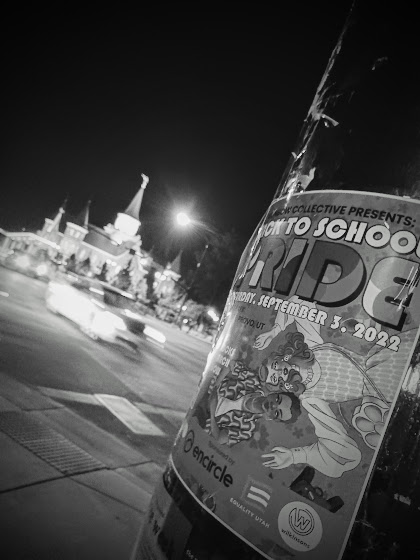
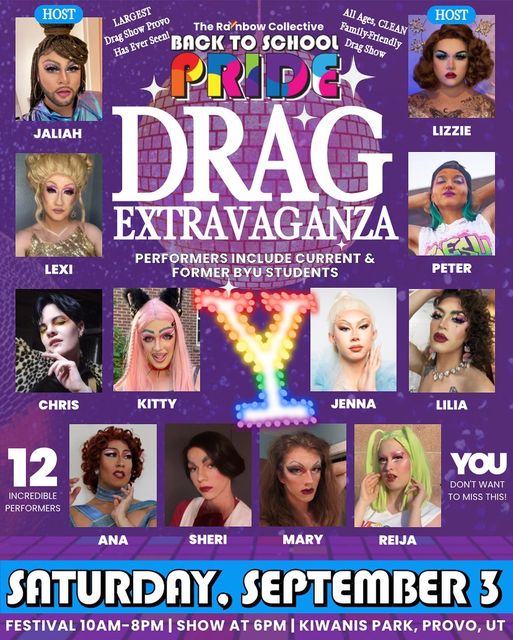
As Raynbow Collective gears up for Saturday’s BYU Back to School Pride night, Provo is suddenly in the national spotlight again. Planned festivities at Kiwanis Park include LGBTQ speakers, a Pride march, live touring bands, vendors and food trucks, but the highlight of the evening is a “family friendly” drag show at 6 p.m.
The celebration is gaining attention across the nation as anti-LGBT sentiments surrounding the drag show have cropped up on social media. Opponents of this form of entertainment are speaking up on numerous websites, including Twitter, Instagram, Reddit, and on YouTube channels.
Additionally, queer BYU students are experiencing intensifying pushback from the predominantly Latter-Day Saint community. On Thursday, Raynbow Collective’s executive director, Maddison Tenney released a video on Instagram speaking to the removal of the event’s signs around town. The RC staff spent long hours putting up the posters, “It makes me really sad that people take opportunities to be kind, and choose violence instead,” said Tenney.
On Provo Forward, a community Facebook page, residents objecting to the drag show shared their opinions. “I love Provo. I love its people. And I love these people. But this is wrong,” posted AnneMarie Pensabene. She argues that accepting the queer community in Provo needn’t include accepting how BYU LGBT students celebrate their identities. She paraphrased a scripture from 1 Corinthians 13:4-8, “Love does not delight in evil, but rejoices with the truth. It always protects, always trusts, always hopes, always hopes, always perseveres.” Pensabene expressed concern that the show will be performed in a public park with children present, and several other residents agreed.
Roni Jo Draper, a BYU professor in theDavid O. McKay School of Education responded.
“Public parks are for the public,” wrote Draper. “Drag performers and people who want to watch their performances are all members of the public. They have the right to use public spaces. Suggesting that they don’t because they are dangerous or deviant is dehumanizing. It is suggesting that they don’t or shouldn’t have the right to public spaces.”
She went on, “You can say it’s inappropriate for your children based on how you want to do your family. But saying it’s inappropriate for all children is not your call.”
BYU faculty member, Kersti Spjut replied to the post. “Like any performance or media, drag shows vary in the degree to which their language and subject matter is appropriate for different ages. The “family friendly” description here functions similarly to a G or PG rating, because drag is not inherently adult content.” She further argued that a G-rated drag show in a public park doesn’t go against laws of public decency or media regulations.
Drag shows involve a performance where the artists—“kings” and “queens”—impersonate men or women, pushing the boundaries of gender presentation while lip-syncing and dancing on stage. Historically, drag can be traced back to 16th century England and China. Since women were prohibited from performing in the theater, men donned feminine attire and performed female roles on stage. Drag continued to be popular for nearly 500 years until 1933 when Hollywood imposed a code of ethics which sought to eliminate drag in film by classifying gender-bending performance as perversion. However, drag shows continued on stage, and rose to popularity in 1920s Harlem. Drag “Balls” featured gays and lesbians in extravagant performances which brought together the LGBT community. These social events gained in popularity, and by the 70s these balls were held across the United States. While originally held in secret and primarily attended by people of color, drag shows are now a familiar form of entertainment for all, regardless of race or sexual orientation. In the media, the documentary Paris is Burning and the television show RuPaul’s Drag Race have broadened interest in the art form.
Drag queens slated to perform at Back to School Pride issued a statement on RC’s Instagram page.
“Drag is far more than ‘a man in a dress’. It’s an art form, an avenue for self discovery and expression. It’s for everyone, no matter your gender identity. It’s a celebration of the Queer community and the diversity within it. Our drag will speak for itself, regardless of the name we go by.”
Reported threats of violence made to Provo City prompted RC to team up with Provo Police Department to ensure the safety of students, performers, and participating residents should there be counter protestors demonstrating at the event. The RC is also asking for donations to provide increased security.
“We want to encourage people to get the word out about Back to School Pride night,” said Tenney. “We want it to be loving and fun, and everyone’s invited.”
 South Provo Prophet