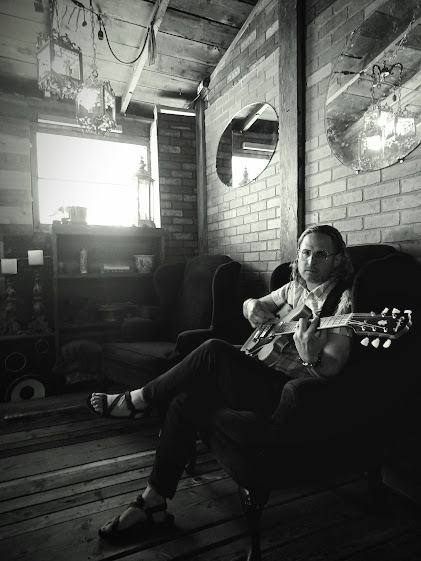
Provo singer/songwriter Justin Duckwitz is an adjunct professor of English at Salt Lake Community college. He has an MFA in poetry from BYU, as well as extensive experience as a chef. In 2012 his street-folk band, Ferocious Oaks, released the album It’s Better This Way. In July, Duckwitz fronted the Provo psych-folk band Wiseteeth, which recently released the album Better Things—songs written by Duckwitz, drummer Clayton Godby, and produced by Bly Wallentine. The EP is available on Spotify, Bandcamp, iTunes, Apple Music, and TikTok. Wiseteeth performed two shows in August; one at Velour, the other at ABG’s. South Provo Prophet sat down with Duckwitz for an interview at Rugged Grounds to talk about the band, their music, and their vision for the future.
Tell me the quick facts about Better Things.
The album is me, Clayton, and Bly Wallentine. Bly added a lot of guitar sounds, keyboard, and bass. It took us from September to July to create the album. It was about nine months, like growing a baby. I was finishing song lyrics right up until the end. Some of them, I would write and then we’d immediately record them. Then we prepared the live shows at ABG’s and Velour.
How did you come to music and song writing?
I started playing at seventeen when my brother gave me a guitar that his friend gave to him; so it’s a hand-me-down, no-name guitar that I still have and prefer playing over some of my other guitars. I really wanted to teach myself. I liked the idea of it being something that I learned on my own. There was some pride in that because I think I could have learned a lot faster if I’d been open to taking lessons. So the way I learned was super slow. I put my fingers all over the fretboard until I found something that sounded like a chord, then I’d just play that. It was so obnoxious, but I just liked the tone of the guitar and noodling. From the moment I picked up the guitar I was writing stupid little one-chord songs. I didn’t have anything I wanted to show anyone until I was 22 or 23. It was a slow process.
How did you and Clayton team up?
I grew up in Provo and Clayton grew up in Orem. Even though we weren’t childhood friends, we can reference things and people and totally get it because we grew up in similar neighborhoods. He really is a lifelong friend even though I didn’t meet him until I was 23. I had written some of my first songs, and one of them was called the “Lemon” song. It was something I was proud of, so I shared it with a few friends. I’d just met Clayton and he was cool; he’d played in several bands. I played this song for him and afterwards he said, “I want to be in a band with you, and I want it to be the SS Justin. I want you to be the frontman, the songwriter. You’re going places.” I only had two songs at this time, and he was this drummer playing with everyone; he had all these connections. Clayton’s been a huge partner for me since 2009. It’s a long run. He was the drummer for Ferocious Oaks, but when he moved out to Wisconsin we thought we were done. Then, last summer, he came back. We hung out, hiked, and talked a lot about music that wasn’t our own. After the hiking season came to an end we had the same thought: “Should we start making music again?” We took all of our instruments to my parent’s cabin that was going unused over the winter. We’d take retreats where we’d go down, look at our songs, and write together. It’s fun working with him because these songs always start out as soft folk songs, but they become heavier rock sounds. It’s cool to see how working with just a drummer they can become that. Clayton and I have always had the same brain about music, which is really nice; having somebody with a similar vision. He sees blindpspots that I don’t see. We’re connected musically that way.
Tell me about your songwriting process.
To me the best part of the guitar is the sound of plucking a single string, and that’s still how I start writing. If I’m alone by myself I’ll curl up and just play the same damn chord eighty times. Writing lyrics is like a vibe. With mine, if I try to write too much about something specific, it’s hard not to sound corny, rote, cliche. So my songs are a bit of word salad with one or two poignant lines. To me it’s never super cohesive, but if you don’t focus on it too much it makes sense.
To me, invention is so fulfilling. So I might practice something that I’ve already written, but my favorite thing to do is mess around, come up with a couple of chords that sound good, and then I’ll sing wordless things that sound like lyrics. I have a million recordings like that on my phone, and when Clayton and I were looking to create a record, looking for songs we’d like to pursue, he and I will listened through all of those recordings. Sometimes I’ll listen to them on my own and I’ll think, ”Oh that one! I want to add real lyrics to that. Let’s turn it into a song.” For every single song there’s millions of b-sides, and c-sides. A lot of songwriting is collaborative. I mean, Clayton? I couldn’t do it without him, maybe because I’m not very confident in my work. It’s nice to take my phone to Clayton, ask him if anything is worth pursuing, and he’ll say, “Oh, I like that one,” or, “I see this kind of drums on this one.” And I’m a sucker for validation, and when he does that I’m all “Okay, Okay!”
What is the main source of your ideas for lyrics?
Even though I love poetry, it’s hard for me to write lyrics for songs. There were a few sources that I build them around. The cool thing about our experiences is that we can reuse them over and over again for poems and songs. William Wordsworth said that by the time you’re eighteen you have enough life experience to write from memory. I haven’t had an amazingly cool life, but I have a few moments that were profound. One of them was when I lived in a tent in Zion National Park. I was dating somebody during that time, and we had a tragic breakup. From that I was able to write some badass poetry. It was beautiful and romantic in that canyon, and I had all of this imagery, but there was also this sense of grief and loss—all the things that great poems are about. With poetry you have to write some bad poems to even just warm up. I’ll think, “Okay I’m going to write some shit,” and then maybe then once I’m comfortable with that I’ll know the parameters I’m working with, and this I take those and apply them to writing something good. I don’t usually write my songs about just one person. Even that song about the romance in Zion, I also steal from other romances too. They’re a hodgepodge of loss and grief, both in romance and friendship. I wrote one song about my wife on Better Things, entitled “The Cassowary Does Not Fly, It Is a Bird of War.” I mention cassowaries in the song at one point and the title is kind of filler for what a cassowary is. It’s about going on a roadtrip with my wife, and the main chorus that I love goes: Babe, you know I’ve got the snacks. You bring on the podcast. And that sums up our road trip experience. I am always a freak about making sure there’s enough snacks, and she has great podcasts to listen to.
What is your favorite song on Better Things?
There’s a song on this album called “Broken Pastures.” We named it even before I wrote the lyrics. Last November I was trail running in Slate Canyon and lost my phone. It was depressing. I had recorded all these little song starts that I hadn’t backed up to the cloud—so much valuable material was just gone. I went up the canyon searching, trying to find it. Then, the next couple of days it snowed, and I figured that was the last of that phone. I got a new phone and Clayton and I started working on Better Things. I had older phones with little starts that we thought we could use for a full album. But three months in, someone emailed me. “Hey! I think I found your phone at the bottom of Slate Canyon.” Somebody found it and brought it to the bottom of the canyon where they left it on some rocks. I assume it fell down between the rocks, because after the snow melted this person found it, took it home, charged it, and it turned on. My gmail popped up and that’s how they contacted me. I was like, no way! They asked, “Do you still want this?” And of course, I was all, “Hell yeah!” I picked it up, listened through a bunch of these songs, and a couple of them are my favorites on the album. The songs “Better Things,” “Den of Teeth,” and “Broken Pastures” were on that phone.
I’m fairly prolific, so I’d forgotten about them because I write so much. One of my favorites on the album is “Broken Pastures.” With my poetry, people are often astonished when I tell them that. I’ll have a four-stanza poem that took me sixteen hours to write. So I made a rule for myself for this album: for each song I’m not going to spend more than three hours on the lyrics. Because of that time limit they might lose some poetic value, but with “Broken Pastures” I feel I was able to tap into a lyrical flow. When it came out it was both beautiful poetry and music. It’s one of my only songs on the album that I think is also a poem. It’s really short—only a minute and thirty seconds—but there’s a line that goes: Pools of emerald fill our hands as we clothe our skin in the summer water. Am I alone when I remember? I like that idea. Am I alone when I remember this day? The idea of collective memory, and yet the memories we have are only ours. It’s precious—memories are precious.
John Goshert played with Wiseteeth at your shows. How did that come about?
It’s a cool story. John Goshert played bass in our shows. I’d taken my first English class at Utah Valley University from him in 2006 and got a C-. I took a hiatus from school, and was kind of aimless for a while. I did band stuff with Ferocious Oaks, worked as a chef and did a lot of cooking. I started feeling aimless again, and went back to UVU to study English. I took postmodern lit from John, and I guess you could say I came back with a vengeance. That’s the cool thing about going back to school as a non-traditional student; you go back with your shit together. I knew what I wanted. I had more of a drive, and I wasn’t going to mess around. After taking this second class with John, I went on to take three more classes from him and this time I did really well. He ended up writing letters of recommendation for me for grad school, and that final semester at UVU he gave me his personal gmail. He said, “I don’t really do this with a lot of people, but we’ve chatted about other things besides academia. Reach out to me; we’re friends now.”
For the shows at ABG’s and Velour we were working with a guitarist who had to suddenly drop out. I’d seen John thrashing on the guitar with Big Trub, so I knew he was in the music scene. I included him in a bunch of emails I sent out to the guitarists I know: “We have a show in three weeks, and we need a guitarist!” John emailed back in less than an hour later. I saw the email—it was like 10 o’clock at night—and I called him. He said, “Hey Justin! I listened to your EP. This isn’t really my genre, but I’m down. What songs do you want me to learn tonight?”
I was stoked. He wasn’t who I’d first envisioned because he’s a punk player, because our sound is psychedelic rock, but I knew he was such a hard worker, and he was also the first person to reach out. I looked at the clock. We had band practice the next day. I said, “You could try these two songs.” And he responded, “OKAY! I’ll learn them tonight.” He played our shows, and I think he lent a real edge to our sound.
What does performing live offer that you don’t get from recording?
I like performing. I think of it as an art form on its own. It’s not about me, which helps me feel comfortable on stage. For the Velour show I prepared monologues for between songs, and those took the pressure off of knowing what to say. They gave me the chance to give shout outs to the band members and people in the audience. Performing really isn’t about me—a whole community that goes into creating this experience—it’s a group effort. Live shows get me out of my head. Ego is an art killer, and performing helps me step out of myself and tap into something more rewarding and meaningful. Still, I’m pretty introverted, so after a show I find a quiet spot where I can just chill out.
What plans do you and Clayton have moving forward?
My wife is faculty at BYU, so we’ll stay at least until my son is eighteen. She and I joke about moving to the east coast, but we love Provo. There’s a lot to love about this place. Slate Canyon, for instance. It’s little known, remote, and nobody wants to climb it because it’s so steep. It’s only three minutes from my house, and I can go there to get the feeling of being deep in the mountains.
Future shows for Wiseteeth are up in the air. Clayton is headed back to Wisconsin, but I like the idea of having stages of writing, playing shows, and recording. Right now I think we’re in the stage of music videos, putting visual art to our shows, and, of course, promotion. Since I’m always curled up with a guitar, writing simple song starts, I hope in time we can pair back up and that it’s a lifetime partnership. I think a measure of success is if we keep going. Making music brings me joy; it’s my art, and I must do it. It’s okay if I look back at Better Things and think, “That was good.” But I’d also like to take another shot at producing an album. I think we can continue indulging in the process, and make the next one even better.
 South Provo Prophet